
Introduction
Miro is a member of the Family Podocarpaceae and originally went by the name Podocarpus ferrugineus. The new genus Prumnopitys was established in 1978 and consists of nine species extending from Costa Rica, through Chile and across to New Caledonia, Queensland and New Zealand. New Zealand has two of these, miro and matai.
History
The Maori people did not use miro timber to any extent but they did make great use of the tree because of the attraction of its fruit to the kereru. Probably because a meal of miro berries made kereru thirsty, hunters would place water troughs near the trees and set snares around them. As Wiremu Puke told the Trust Conference in Hamilton, trees were often tribal landmarks in their own right; trees that are unusually formed or misshapen often have special powers of tapu. There is a pa called Miropiko on River Road (in Hamilton) which means crooked miro tree and this was a special tree where pigeon were snared. The other main use made of the miro by Maori was medicinal. An oil expressed from the drupes was used as an insect repellent when rubbed onto the skin and was also given to help recover from fever. The gum exuding from the bark was applied to wounds and ulcers, a liquor prepared from leaves and bark was taken internally for gonorrhoea and a bark infusion used for stomach ache. The early Pakeha bushmen also used miro as an antiseptic. The bled resin and the bark are a rich source of diterpenoides. Maori also ate the fruit, despite it smelling and tasting like turpentine. European use of the timber had seen it usually sawn and sold as rimu but it is an inferior timber (see below). Its main claim to fame in earlier years seems to have been its strength, often being used for beams.
Distribution
Miro is found throughout New Zealand, being found wherever rimu grows and is most common on the West Coast. It grows up to about 1000 metres a.s.l in the North Island, to 750 metres in the South Island and only 300 metres on Stewart Island. Miro is found on most soil types but does not do well on waterlogged or droughty sites
Tree size and growth
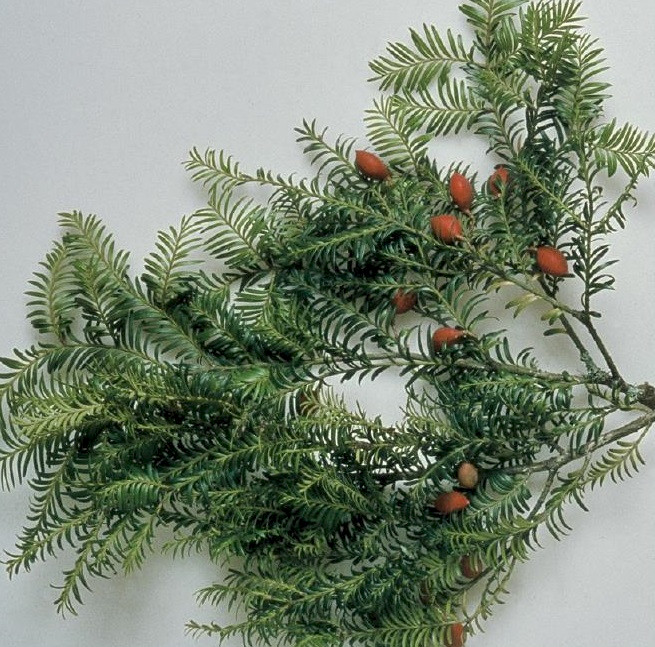 Photo: H Janssen, Bush Vitality AssessmentAllan records miro as growing to 25 metres tall and one metre diameter. However it has been known to reach 30 metres height and 1.25 metres diameter. The only tree recorded in Burstall and Sale is one that was probably planted near New Plymouth and is the largest open grown miro recoded. However it has only reached 14 metres height and 87 cm diameter.
Growth data for planted trees is relatively scarce. The best height growth appears to be 28 cm annually and the best diameter growth about 5.8 mm. Averages are much less with height about 20 cm and diameter 4 mm.
Timber
Timber characteristics, with P radiata figures shown in brackets for comparison, are as follows: -
Density: 625kg/ m³ (500 kg/m³ )
Moisture content: green heart 98 % (130%)
Tangential shrinkage -green to 12% m.c 5.9% (4.7%)
Radial shrinkage 2.5% (2.2%)
Modulus of rupture 94Mpa (90 Mpa)
Modulus of elasticity 10.1Gpa (9 Gpa)
The heartwood is light brown in colour with a greyish tinge and dark red/black streaks. It has a reputation for distortion and, when sold mixed with rimu, often caused problems leading to it being culled for many uses. Its main uses are flooring, weatherboarding and furniture.
Potential
Because of its relatively slow growth rate and the difficulties with using the timber, miro has only a minor place as a timber tree at this time. However it is a very important biodiversity species which seeds almost every year and provides important food for several important bird species. It is considered that a few miro should always be planted, along with those used for timber, whenever any major planting is undertaken.
Research requirements
Miro has the ability to survive in relatively low light conditions but also, as a mature tree, will grow in full light. Establishment trials to enable it to be successfully grown for biodiversity purposes are needed. It is likely that miro should be planted after most other species are reasonably established – about 5-8 years after the main planting is done. It is also likely that, providing berry bearing trees are planted early (eg. Coprosma), birds visiting to feed on them will bring miro into a newly established area. How these seedlings are managed will also require some investigation.
References
- Allan H H. 1961. Flora of New Zealand Vol. 1 Government Printer Wellington
- Brooker S G, Cambie R C & Cooper R C 1981. New Zealand Medicinal Plants. Heinmann
- Brooker S G, Cambie R C & Cooper R C 1988. Economic native plants of NewZealand. Botany Division D.S.I.R
- Burstal S W & Sale E V 1984. Great Trees of New Zealand
- Clifton N C 1990. New Zealand timbers. GP Publications
- Farjon A 2001. World Checklist and bibliography of Conifers (2nd ed) Royal Botanical Gardens, Kew
- Hinds H V & Reid J S 1957. Forest Trees and Timbers of New Zealand. Govt Printer Wellington
- Orbell M 1985. The natural world of the Maori. Collins, Auckland. 230 p
- Pardy G F, Bergin D O & Kimberley M 1992. Survey of Native tree plantations. FRI Bulletin 175
Species profile by Ian Barton