
History
Maori used the wood of hinau to make various small implements like canoe bailers, spears and wedges. Of greater importance was the fruit which was crushed, mixed with a little water and made into cakes which were cooked in a hangi. The bark was used to make a black dye and would also fix dyes and for this purpose may have been exported in the early years of European settlement. A decoction of bark in hot water was also used to cure skin diseases. Early European use was as a general purpose hardwood and although there is normally little visual difference between the sap and heartwood, old trees developed a black heart which was very durable and used for house piles and posts. More recently the timber has been used for boat and motor body building, furniture, turnery and flooring.
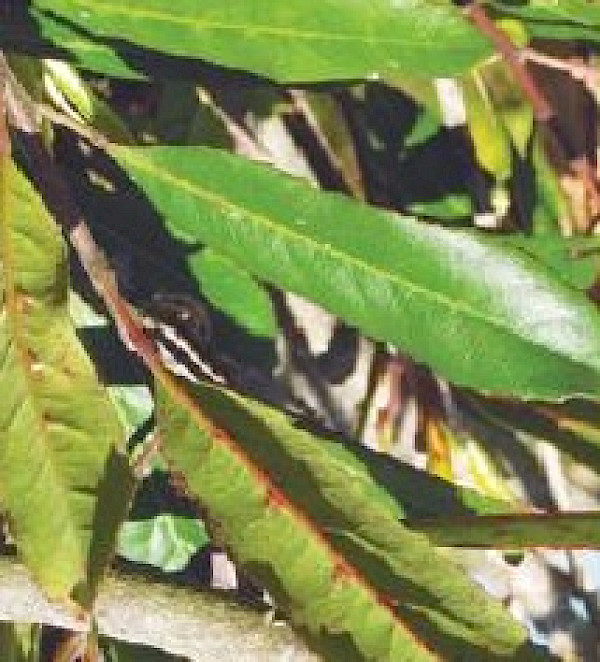 Photo: H Janssen, Bush Vitality AssessmentDistribution
One of the most widely distributed New Zealand hardwoods, hinau ranges from North Cape to Banks Peninsula, although it is not common in the South Island and is not found on Stewart Island. In the North Island it is found to 1000 metres altitude but is more common below 750 metres. In the South Island it is rare above 50 metres but will grow to 380 metres. Hinau is moderately frost hardy, although where frost is severe it is confined to fertile soils. The species requires high rainfall for good growth unless the soils are moisture retentive. It is found on a wide range of soils, especially the pumice soils of central North Island, but in the South is usually restricted to more fertile sites.
Tree size and growth
Normally between 15 and 20 metres tall and 60 to 90 cm d.b.h but can reach 1.2 metres. The merchantable height is seldom over 9 metres. Hinau is known to reach 50 cm d.b.h in 100 years. Measurements of trial plantings in six New Zealand locations showed initial height growth of about 40 cm per annum, slowing to less than 20 cm for 80 year old trees. Diameter growth averaged just over 6 mm per annum. Assuming that more carefully managed planting could grow slightly faster, it is reasonable to expect that trees 18 metres tall and 50 cm diameter could be grown in 70 years.
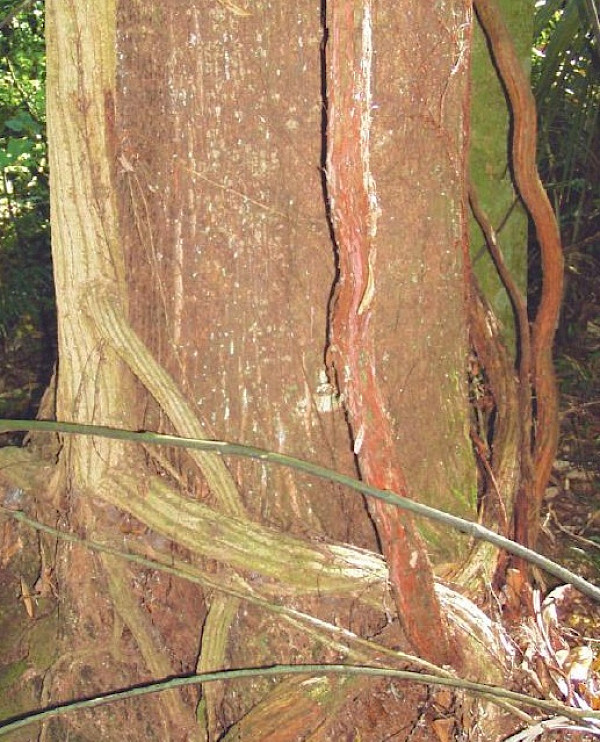 Photo: H Janssen, Bush Vitality AssessmentTimber
The wood is light brown in colour, tough, strong but non-durable, although the black heart will last up to 25 years in the ground. Being of similar colour, the sap and heartwood cannot easily be distinguished from each other although the heart is slightly more durable than the sap, lasting up to 10 years in the ground. Sap and heart are moderately resistant to pressure treatment but can be treated. The wood has a fine even texture which dries, machines and finishes well.
Timber characteristics, with P radiata figures shown in brackets for comparison, are as follows: -
Density @ 12% m.c 705 kg/ m³ (500 kg/m³)
Moisture content: green 96% (130%)
Tangential shrinkage - green to 12% m.c 7.0% (4.7%)
Radial shrinkage 2.6% (2.2%)
Modulus of rupture 89 Mpa (90 Mpa)
Modulus of elasticity 10.4 Gpa (9 Gpa)
Damaging agencies
Hinau is a hardy species which, while host to several scale insects, seems little affected by them. The sapwood is attacked by the common house borer.
Potential
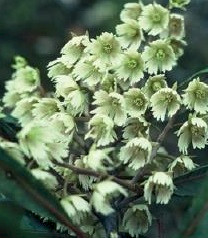 The white flower petals are deeply incised. Photo: H Janssen, Bush Vitality AssessmentIt would seem that there is room to explore further potential uses of hinau; particularly uses requiring strength and toughness. Its utilisation for furniture seems also to have been overlooked.
Research requirements
Trials to determine optimum site requirements and growth rates are urgently needed, as is further work on its chemical attributes.
References
- Allan H H 1961. Flora of New Zealand Vol. 1 Government Printer Wellington
- Brooker S G, Cambie R C & Cooper R C 1988. Economic Native Plants of New Zealand. Botany Division, D.S.I.R
- Brooker S G, Cambie R C & Cooper R C 1981. New Zealand Medicinal Plants. Heinmann
- Clifton N C 1990. New Zealand timbers
- Hinds H V & Reid J S 1957 Forest Trees and Timbers of New Zealand. Govt Printer Wellington
- Howard A L 1948 A manual of the timbers of the world. MacMillan & Co, London
- Pardy G F, Bergin D O & Kimberley M O 1992. Survey of Native tree plantations. FRI Bulletin 175
Species profile by Ian Barton