
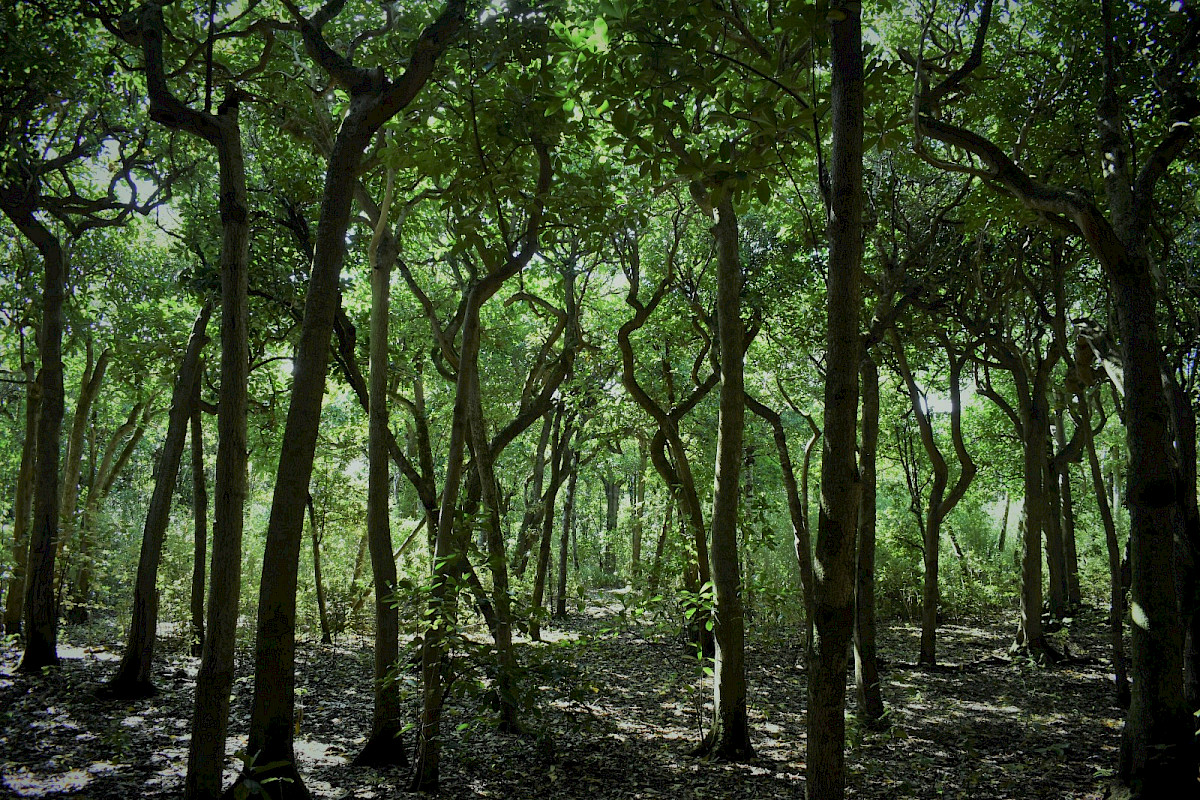
Welcome to Murkwood, Tāne’s Tree Trust’s philosophical forest. It is intended to be a magical and tapu place for stimulating ideas, considered discourse, and deliberations. But also, for forest-related art and inspiration.
It’s a seed bed and nursery for free thinking, but also a venue for respectful criticism and diverse opinion. There are no set paths, and if there were, you wouldn’t have to stick to them. You are invited to walk in bare-footed, to listen, and even to submit your own offerings. These could be think-pieces, or partially-formed ideas, theoretical ponderings and essays. An understory of critical reflections, self- doubts and humour is especially welcome. But art, images and other misfits may find space too.
The sign at the thicket’s edge, demands only respectful conduct. However, there is an expectation that topics will generally be relevant to forests, nature, conservation, and our cultural relationships to these things. Politics and business interests will be weeded out.
Disclaimer:
The contents of this page do not represent the view of Tāne’s Tree Trust, its trustees, or membership. No items shall be copied, quoted, or used in anyway without the author’s written approval.
Submissions can be made to [Enable JavaScript to view protected content]
Authorship must be supplied and will be published with all selected submissions.
The Conservation Revolution
Here is a link to a review of the book: The Conservation Revolution: Radical Ideas for Saving Nature Beyond the Anthropocene
The review itself does a great job of outlining the basic concepts argued in the book – including the term “convivial conservation”, but it also efficiently delivers a some useful critique. It is itself well considered, well referenced and well worth reading.
Click here to read the review.
Three more essays
Here are three more findings in the philosophical forest. For those of us who feel deeply connected to nature, prefer native forests, and yet like to have our own biases and prejudices challenged, these are great grist for the mill.
First is William Cronon’s 1995 essay titled: The Trouble with Wilderness; or, Getting Back to the Wrong Nature. This is a big, well-established and often cited tree. Essential reading! It illuminates just how ideas of nature are always human cultural constructs, and how problematic contemporary western notions of wilderness are:
https://www.williamcronon.net/writing/Trouble_with_Wilderness_Main.html
The next is an easy, short, and accessible piece by Mark Davis on defining nature. It carries on from Cronon, and usefully puts the dominant contemporary (western) conservation paradigm (i.e., ecological nativism) in an historical context – having reigned since the 1980’s, but now being challenged by paradigms grappling with accepting the inevitability of ecological novelty:
https://metode.org/issues/monographs/defining-nature.html
And the third, is a more recent (2025) paper that considers the present native-exotic dichotomy in conservation through the understanding that this is an evolving cultural lens. It asks, and partly answers, the question of what this means in regard to where to next?
https://anthroecology.org/wp-content/uploads/2025/08/van_eeden_2025a.pdf
The Desert Ahead
The following is a chapter excerpt from an entertaining book by Jon Dronfield. It provides a travelling forester’s musings on culture and ecology in reaction to a sparse forest of argan trees in an arid, rural landscape of Morocco.
Click here to read (PDF, 75.65 kB)
The book, On Roman Roads - dispatches and reportage from a year on the road, is available from: [Enable JavaScript to view protected content]
Weeds, War, and reconceptualising nature in Aotearoa, New Zealand - A provocation to theorists from a practitioner at the coalface
By Paul Quinlan - October 2025
Abstract
Warning: This essay contains disturbing ecological forecasts and challenges to mainstream cultural attitudes towards weeds, our idea of nature, and the future management of native forests in Aotearoa, New Zealand. It will argue we need to dismantle popular but inadequate environmental dogmas, which will be galling to many. However – spoiler alert – it concludes, optimistically, that environmental weeds will ultimately force us to create more adequate conceptions of nature, and pragmatic management approaches.
In short, it will be good for us, even if we hate this prospect at present. And no, the word hate is not too strong (I predict the strongest reactions will be from those who love native forests the most. And I sympathise completely).
Let’s cut straight to the nub. There is an insurmountable environmental weed problem coming to rural New Zealand. It won’t be beaten by chemical or biological warfare, updating noxious pest plant lists, mobilising the unemployed, volunteers, high-tech drones, or by planting native trees. This apprehension is based on observations and decades of professional experience and has led to my premise that it’s a battle that can really only be won in our minds; we need a change of mindset. Environmental weeds will eventually force us to reconceptualise ‘nature’ in Aotearoa, New Zealand.
Download a copy of the essay here.