
History
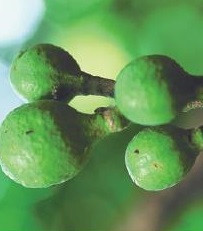 Kohekohe seed capsules, containing three large seeds. Photos: H Janssen, Bush Vitality AssessmentMaori used kohekohe for river canoes, although it was difficult to find trees large enough. It was highly regarded for this purpose, giving canoes which were swift and strong. However its rapid rate of decay meant that it was not used for many other purposes. Medicinally it was important and was used in various ways; the leaves which contain a bitter component similar to quinine, were used for a range of illnesses including consumption, coughing, sore throats, boils and women’s disorders. A decoction of kohekohe bark and supple-jack roots was taken three times a day before meals for sexual diseases, while a mixture of kohekohe bark and parts of several other species relieved bleeding and general blood disorders.
Europeans soon saw that the wood of kohekohe was superb for furniture making; it is after all a member of the same family as mahogany. Unfortunately it does not have the same stability as that timber and its main attribute is the attractive reddish-brown finish. Because kohekohe seldom grows to a large size without becoming hollow, its timber potential has never been fully explored.
Distribution
Like many New Zealand species kohekohe has an interrupted distribution, being commonest from Kaitaia south to a line between East Cape and North Taranaki but appearing again around Queen Charlotte Sound. It is generally more common in coastal and lowland forests. A study done in the Hunua Ranges, south of Auckland, shows the species to be an important component (30%) of the sub-canopy stratum in the Beilschmiedia / Dysoxylem forest type. It is a minor dominant (8%), but important in the scrub stratum (23%). In the Hunua Ranges kohekohe is mainly found between altitudes 200 and 500 metres. No information on site preferences has been located but it is expected that kohekohe will grow faster on good loamy soils where the rainfall is between 1600 and 2000mm per annum. It will probably not establish where rainfall is < 800 mm per annum.
Tree size and growth
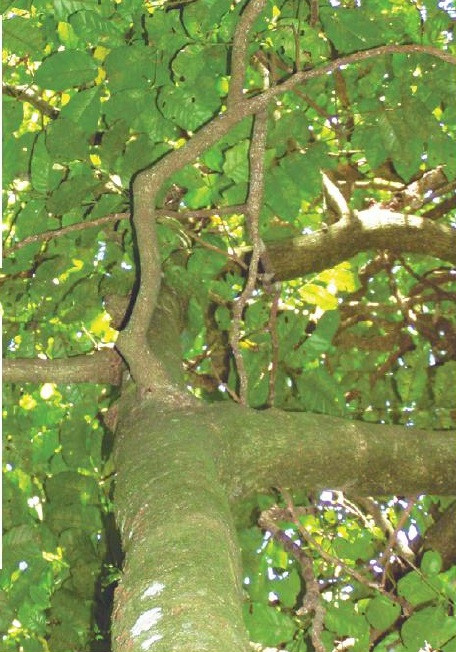 There is little information available on the growth rate of kohekohe. Trees normally grow to about 15 metres tall and 100 cm diameter, although the large tree in Brooklands Park, New Plymouth was almost 20 metres tall and 200 cm in diameter in 1983. The only data recorded for planted trees showed a height growth rate of 0.2 to 0.28 metres per year and 0.26 to 0.57 cm diameter growth per year. Observations of seedling/sapling growth in a protected regeneration area suggest that growth rates will exceed those given above if the trees are on a suitable site and are appropriately managed.
Timber
The heartwood of kohekohe is described as an attractive light reddish brown with a fine, even texture; the sapwood is brownish-white. The wood is relatively soft and easier to work than tawa and taraire. It takes a high polish and is often referred to as New Zealand mahogany. Timber characteristics, with P radiata figures shown in brackets for comparison, are as follows: -
Density: (at 12% M.C) 545 kg/ m³ (500 kg/m³ )
Tangential shrinkage -green to 12% m.c 6.9% (4.7%)
Radial shrinkage 4.2% (2.2%)
Modulus of rupture (air dry) 70Mpa (90 Mpa)
Modulus of elasticity (air dry) 9.5Gpa (9 Gpa)
Potential
Kohekohe is a species which should receive a lot more attention because indications are that its growth rate on good sites could be quite fast. The fact that most naturally grown trees tend to be somewhat misshapen and hollow when over about 60 cm diameter may be the result of their growing on poorer soils and competition from other forest trees. A point in its favour is that it is highly shade tolerant which means it has good potential for Continuous Cover Forestry and can be grown in mixtures with species like kauri, totara, Tasmanian blackwood and Cupressus species.
Research requirements
 Research into its optimum growth conditions is urgently needed. Being a species which germinates readily from seed, its propagation should be fairly straight forward. Planting trials involving pure kohekohe stands and mixtures with other species on a range of soils would be a useful first step. Laboratory studies to determine its moisture, light and temperature requirements should be done as soon as possible.
References
- Allan H H 1961. Flora of New Zealand Vol. 1 Government Printer Wellington
- Barton I 1989 Vegetation of the Hunua Ranges. Report prepared for the Auckland Regional Authority. 20 p. plus appendices, tables maps etc
- Barton I (In press) Continuous Cover Forestry: A primer for the management of New Zealand forests.
- Brooker S G, Cambie R C & Cooper R C 1981. New Zealand Medicinal Plants. Heinmann
- Burstal S W & Sale E V 1984. Great Trees of New Zealand
- Clifton N C 1990. New Zealand timbers
- Hinds H V & Reid J S 1957. Forest Trees and Timbers of New Zealand. Govt Printer Wellington
- Pardy G F, Bergin D O & Kimberley M O 1992. Survey of Native tree plantations. FRI Bulletin 175
Species profile by Ian Barton