
Introduction
Kahikatea grows throughout New Zealand and is commonest in riverine and swamp forests where it is often found in almost pure stands. It was in such a location, on the Waihou River near Thames, in 1794 that the British ship Fancy secured 200 spars ranging in length from 18 to 43 metres. Although kauri was growing on nearby hills it is recorded that most of this cargo was kahikatea which soon rotted. The susceptibility of sap kahikatea to borer and rot has severely limited the use of the timber of this species because heartwood, which is reasonably durable, is slow to form and is more prominent in kahikatea from hilly sites.
History
The Tuhoe people reputedly used kahikatea for carving because it carves easily across the grain and holds a sharp edge. But because of its perishable nature no early carvings have survived. In places where totara and kauri were not available it was also used for canoes and soot from burnt wood was used as a tattooing pigment. A decoction of leaves was used for urinary and other internal complaints and a recipe involving bark for bruises. The other main use by the Maori was of the swollen seed receptacle (usually referred to as a berry) which is used as a food. Often present in large quantities, it was easily collected and there are records of feasts where 60 baskets of kahikatea berries were provided. The prolific production of fruit also attracted pigeons and tui so these forests were good places to hunt. Apart from misuse of the timber for naval purposes, the early Europeans sawed logs into wide clear lengths of timber which were exported to Australia, but use was limited until it was discovered that it did not taint food. Thin boards were then used to make boxes in which butter was packed for export and this continued until the advent of the strong cardboard box. With the advent of treatment against borer most sawn timber went into wide facia and weather boards. Because it is light and easily worked it was also used for boat building and is still in demand today. A recently discovered use, linked to its freedom from odour and taste, is as cake baking container.
Distribution
The Genus Dacrycarpus consists of species of tall trees found from Burma and China in the north, through New Guinea to New Zealand. The sole New Zealand species is kahikatea which is found throughout the country and may have been our commonest conifer. In the North Island it grows from sea level to 750 metres, this upper level decreasing further south so that it is scarcely above sea-level on Stewart Island. It is most abundant in high rainfall areas and occupies a wide range of soils. The fastest growth rates are on deep, well drained river terraces.
Tree size and growth
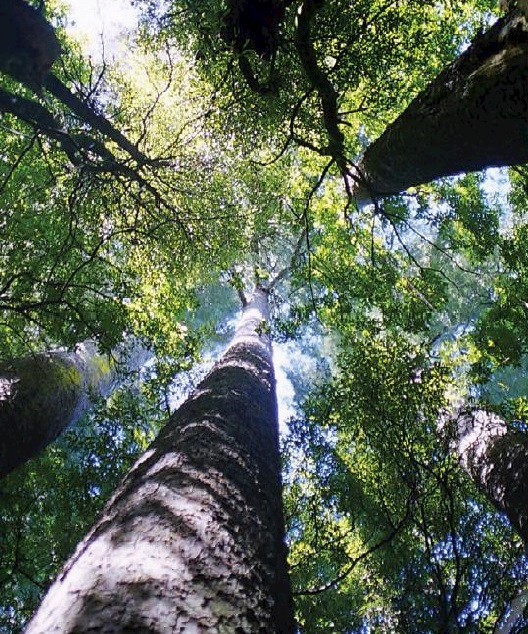 Photos: H Janssen, Bush Vitality AssessmentKahikatea grows into a very large tree, up to 60 metres tall (which only rimu and kauri occasionally exceed) and 1.5 metres in diameter. The largest tree recorded in Burstall and Sale is near Ngongotaha and in 1980 was 50 metres tall and 1.84 cm diameter. Annual growth rates of planted trees range from 10 to over 70 cm height and 8 to 108 mm diameter. The poorest site was on sand at Woodhill forest and the best on volcanic soil at Cornwall Park, Auckland and at Holt’s Forest, Hawke’s Bay, on moderately leached yellow/brown pumice soil derived from Taupo ash.
Timber
Kahikatea heartwood is bright yellow and the sapwood creamy white and often at least 20 cm wide, even in old trees, compared to about 5 cm in other conifers. Sapwood can be treated to prevent borer attack but not for ground treatment with CCA preservative. Timber characteristics, with P radiata figures shown in brackets for comparison, are as follows: -
Density: 450 kg/m³ (500 kg/m³)
Moisture content: green heart 110% (130%)
Tangential shrinkage - green to 12% m.c 4.1% (4.7%)
Radial shrinkage 2.3% (2.2%)
Modulus of rupture 75 Mpa (90 Mpa)
Modulus of elasticity 10.7 Gpa (9 Gpa)
Potential
Kahikatea is easy to establish and grow and its relatively fast growth and potential for many uses when treated, suggests that kahikatea should be given greater prominence than it is. Because of its prolific fruiting habit it is also important for bio-diversity.
Research requirements
Very little research has been done on this species so work in all areas will yield important information. Of greatest need is acquiring better information on siting and establishment techniques. The fact that it is easy to grow on a range of sites suggests that it will not be difficult to improve performance.
References
- Allan H H. 1961 Flora of New Zealand Vol. 1 Government Printer Wellington
- Barton I, Tāne’s Tree Trust 2008. Continuous Cover Forestry; A handbook for the management of New Zealand forests.103 p.
- Best E 1942. Forest lore of the Maori. Govt Printer, Wellington
- Brooker S G, Cambie R C & Cooper R C 1981. New Zealand Medicinal Plants. Heinmann
- Brooker S G, Cambie R C & Cooper R C 1988. Economic native plants of NewZealand. Botany Division D.S.I.R
- Burstal S W & Sale E V 1984. Great Trees of New Zealand
- Clifton N C 1990. New Zealand timbers GP Publications
- Farjon A 2001. World Checklist and bibliography of Conifers (2nd ed) Royal Botanical Gardens, Kew
- Halkett J and Sale E.V 1986. The world of the kauri Reed Methuen
- Hinds H V & Reid J S 1957. Forest Trees and Timbers of New Zealand. Govt Printer Wellington
- Pardy G F, Bergin D O & Kimberley M 1992. Survey of Native tree plantations. FRI Bulletin 175
Species profile by Ian Barton