
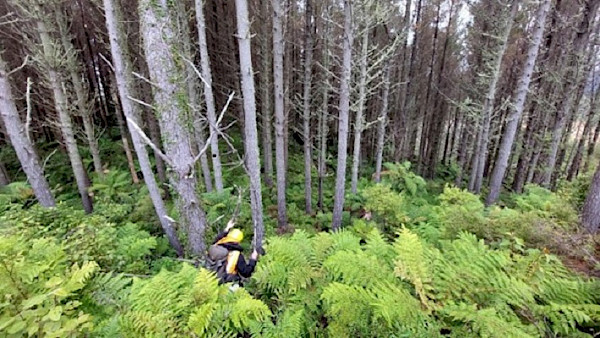
 Native regeneration under mature pine, Gisborne. Photo: Meg GraemeIntroduction
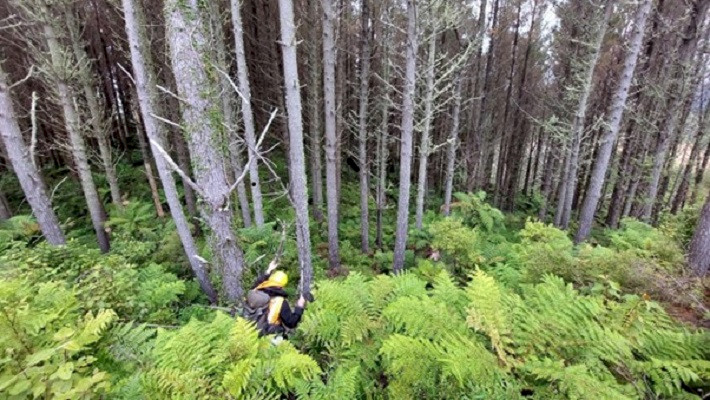
This Tāne’s Tree Trust research project aims to inform the transitioning of exotic forest to native forest. This is a five-year project supported by MPI through the Sustainable Food and Fibre Futures fund, and our forestry partners.
Background
The advent of permanent forestry and carbon farming under the Emissions Trading Scheme (ETS) has sparked debate on the potential to manage transitions from exotic to native forest. The case for using fast growing exotic trees (e.g., Pinus or Eucalyptus) as the primary vehicle for rapid early carbon storage is compelling and is garnering much interest among landowners interested in permanent forestry options. In other circumstances, large tracts of exotic plantation on highly erodible or environmentally sensitive sites (e.g., Tairāwhiti) will need alternative forest management options to conventional clear-fell harvesting. Likewise, effective management options need to be explored for areas afflicted with wilding conifers where a transition to native forest is conceivable (e.g. see video: https://vimeo.com/592450395).
Extensive pine planting programmes have been established with support from Te Uru Rākau and have been incentivised by the ETS. Irrespective of any changes that might occur to the definition of permanent forest in the NZ ETS, permanent exotic forestry is already a major land use across NZ and we urgently need research to guide its management. This research will help inform relevant policy settings and regulation on this matter, and to inform forest establishment and management practices, to ensure that successful transitions to native forest does indeed occur.
Project progress in 2026
The Preliminary Guidelines for transitioning exotic pine forest to native have been finalised and can be downloaded below.
Monitoring of the long-term trials is continuing with remeasurements scheduled for this autumn/winter.
Project progress in 2025
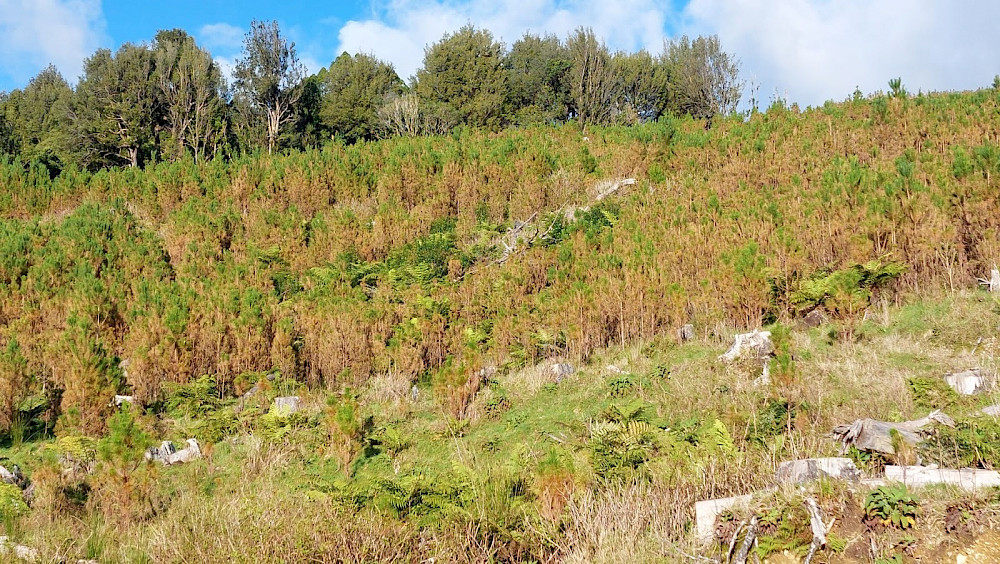 The project is now halfway through with the majority of the field work now completed. The team has been busy writing up results from the different workstreams.
Land Use and Carbon Analysis System (LUCAS) plot analysis: This workstream was led by Dr Mark Kimberley. LUCAS data was made available to TTT by the vast majority of the large forestry managers. This provided 197 grid locations around NZ of which 90% were radiata pine stands, providing 473 plot measurements (many plots had repeat survey data).
Key findings included:
- Radiata-pine forests have more diverse understorey than Douglas-fir forests
- Variable native understorey density/diversity throughout NZ
- Key understorey species in terms of carbon were - māhoe, wineberry, tree ferns, kānuka, putaputawētā, tutu, tree fuchsia, patē, mānuka, karamū and tōtara (the only one true canopy tree species)
- Key exotic species in terms of understorey carbon were - Radiata pine, gorse, Douglas-fir, Contorta pine, blackwood, poplar
- Native understorey plant density and diversity increases with stand age and decreasing stand density (≤ 250 stems/ha)
- Naturally regenerating Radiata pine was absent in first rotation stands but present in young second or later rotation stands - however became an increasingly minor component with stand age
- Carbon in the understorey was 3.8 tCO2/ha, only a small fraction of the carbon stored in the crop trees (av. 215 tCO2/ha)
National bioclimatic surveys: This workstream was undertaken by Dr Adam Forbes to assess the potential bioclimatic influences that may affect how easily an exotic to native forest transition may occur. A total of 80 plots were surveyed in Northland, Gisborne, Waikato, Bay of Plenty, Wellington, Marlborough, West Coast and Otago. Analysis found that native understorey varied with:
- Climate
- Elevation and aspect
- Plantation top height
- Nearby indigenous forest, and
- Level of browsing
Tairāwhiti canopy density surveys: This workstream was led by Meg Graeme to assess the effect of canopy density on understorey characteristics at a regional scale. A total of 45 plots were surveyed at 24 sites throughout the Tairāwhiti/Gisborne region. The plots targeted older stands (av. 37 years). The understorey analysis found:
- Widespread browse
- Understory was predominantly native 98.2%
- Tairāwhiti understorey stem density, carbon and species diversity ranked higher than national LUCAS metrics
- Mainly shrub species (76%) and subcanopy species (21%)
- But carbon mainly in subcanopy species and tree ferns
- Tall canopy species made up 1.8% of stems but contributed 8% of carbon
- Number and density of species, as well as carbon, increases with plantation age
Long-term trials: This workstream is led by Michael Bergin and will be monitored until the end of the project in 2027. These trials provide nationally relevant permanent sample plots to inform carbon and biodiversity forestry models and to help refine management practices. Paired poisoned/unpoisoned canopy plots with and without fencing have been set up in Omahuta Forest (Northland), Whangapoua Forest (Coromandel) and the upper Maitai (Nelson). These are surveyed annually to gather data on understorey planting and natural regeneration survival and growth. Fenced and unfenced sub-plots beneath the poisoned and unpoisoned treatment areas are measured for natural regeneration and survival/height and vigour of plantings. Evidence of deer, goat and possum browse on certain plant species is already clear and we may be able to discern whether pig rooting has an effect on natural seedling regeneration by the end of the project. Early signs of weed establishment have been noted in the Whangapoua poisoned trial plots. Data analysis in 2027 will indicate whether any significant trends are apparent from the early establishment phase of these trials.
Carbon modelling: This workstream is led by Mark Kimberley and assesses various scenarios for a pine to native transition. Based on certain assumptions, scenarios are provided for pine stand transition trajectories with no major disturbance events, through to planned early intervention in killing the pine canopy. This provides useful information to help forest managers and policy makers plan for the inevitable carbon ‘dip’ that occurs when the pine canopy is removed or senesces, and before any regenerating native forest can put on significant growth.
Preliminary transition guidance: The project team is currently working on providing draft guidance that will be reviewed before being published. This will summarise our transition findings to date and help information practitioners’ considerations and planning in undertaking a pine to native forest transition. This guidance will be updated at the end of the project.
Results, including management recommendations, will be freely and widely disseminated to landowners, forest owners, forest managers, policymakers and regulators. Currently available reports and other information can be found on the TTT Project website page at https://www.tanestrees.org.nz/projects/transitioning-exotic-forest-to-native/
We thank everyone who has assisted Tāne’s Tree Trust with this project including the Ministry for Environment, Summit Forests, Ernslaw One Ltd, Aratu Forests Ltd, Ngati Porou Forestry, Juken NZ Ltd, Manulife Forest Management NZ Ltd, Pan Pac Forest Products Ltd, Rayonier Matariki Forests City Forests, Tasman Pine Forests Ltd, Ngāi Tahu Forestry, OneFourtyOne, Gisborne District, Nelson City Council and Northland Department of Conservation.
Newsletters
See update newsletters:
- Newsletter March 2023 (PDF, 466.41 kB)
- Newsletter October 2024 (PDF, 829.96 kB)
- Newsletter August 2025 (PDF, 860.68 kB)
- Newsletter March 2026 (PDF, 311.91 kB)
Project reports
The following project reports are available for downloading:
- Carbon and biodiversity in the understory vegetation of New Zealand’s exotic tree plantations (PDF, 950.38 kB)
- Native understory characteristics of pine plantation stands in Tairāwhiti, New Zealand (PDF, 2.69 MB)
- Transitioning Exotic Forest to Native - Bioclimatic Survey Report (PDF, 768.38 kB)
- Modelling carbon stocks in transition forests (PDF, 1.45 MB)
- Preliminary Guidelines for Transition 2026 (PDF, 5.91 MB)
Published papers
- Native understory of pine plantation stands in Tairāwhiti, New Zealand. Meg Graeme, Mark Kimberley and Mike Bergin. First published in NZ Journal of Forestry, August 2026, Vol. 71, No. 2 pp10-17 (PDF, 898.57 kB)
- Carbon and biodiversity in the understory vegetation of New Zealand’s exotic tree plantations (PDF, 330.98 kB) - NZ Journal of Forestry, February 2026, Vol. 70, No. 4, pp. 23-29
Contacts for this project
- Meg Graeme, Project Manager [Enable JavaScript to view protected content]
- Paul Quinlan, Trustee, Tāne’s Tree Trust
- TTT Executive Officer: [Enable JavaScript to view protected content]